AI Agent Security & Governance Platform
The platform purpose-built to secure the decision. Surfacing exposure, steering actions, and closing gaps, continuously.
The Platform for AI Agent Security
As organizations adopt AI agents across SaaS, cloud, and custom stacks, security for AI agents requires more than model-layer controls or prompt filters. Zenity is an AI agent security platform built specifically to govern how agents behave, not just what they say or generate.
Our AI security agents work continuously, surfacing what's exploitable, enforcing policy at the moment of action, and detecting threats agents create or encounter at runtime. Whether you call them security agents, governance agents, or policy agents, the function is the same: give security teams real control over autonomous execution, at enterprise scale.
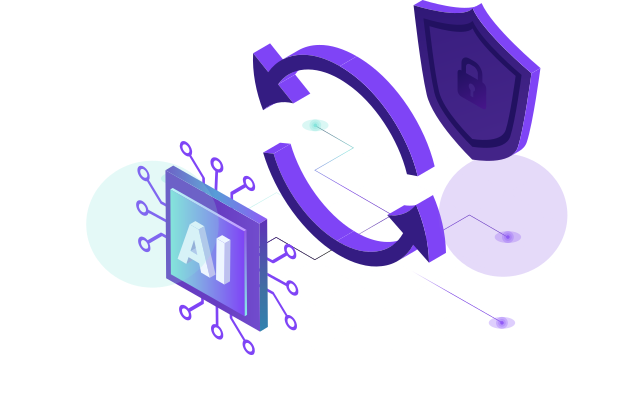
Every Layer Feeds a Decision
An agent's decision draws on what it can reach, who it's acting for, and what it's actually trying to do, and none of that shows up in a single view point. A correctly permissioned agent can still turn into a breach. A risk that looks theoretical on paper can be sitting on a server, fully exploitable. Watching the decision means watching all of it at once, which is why the platform is built in three layers instead of one.
Purpose-built, Full-Coverage Security and Governance
Surface gathers what a decision depends on what an agent can reach, how it's configured, and what's actually exploitable. Enforce acts at the moment a decision gets made, letting a safe action through and stopping an unsafe one cold. Protect watches what happens next, catching anything that slips through and turning it into a sharper rule. Together, the three layers cover a decision before, during, and after it happens.

All Platforms. Everywhere.
AI agents already span SaaS, cloud, custom stacks, and endpoints. Control gaps expand as fast as adoption.
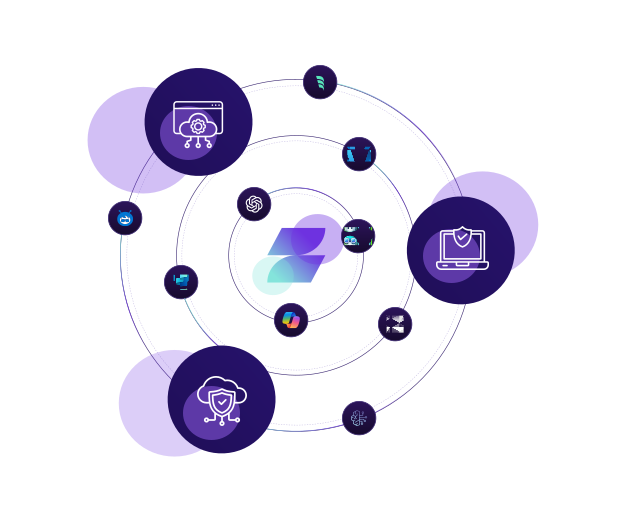

Agentic SaaS
Secure AI Agents embedded in your productivity tools like Salesforce Agentforce or built with one like Copilot Studio - with full visibility and policy enforcement.


Built for Enterprise AI Agent Security
Enterprise environments don't adopt one AI agent at a time. They adopt hundreds, across SaaS copilots, custom-built agents, and endpoint tools, often faster than security teams can track. An enterprise AI agent security solution has to match that scale without slowing adoption down.
Zenity is trusted by Fortune 500 and Fortune 50 enterprises to secure AI agent deployments end-to-end:
- Unified visibility across every agent, every environment, and every identity; no per-team or per-tool blind spots.
- Policy enforcement at runtime, consistently applied whether an agent runs in Salesforce Agentforce, AWS Bedrock, or a developer's IDE.
- Continuous exposure testing that validates which risks are actually exploitable, so security teams aren't chasing theoretical findings.
- Compliance-ready reporting mapped to OWASP and MITRE ATLAS, built for audit and board-level visibility.
Zenity was named a Market Shaper in Gartner's AI Application Security report and is recognized as a leader in enterprise AI agent governance.

Traditional Tools Were Not Built with Agents in Mind
Most existing security tools, including model-focused controls and legacy platforms, were not designed to govern autonomous execution. While they remain critical for securing infrastructure, identities, and data, they lack visibility into how agents reason, chain actions, and operate across systems. Traditional tools fail because agents execute decisions, not just code paths or requests.
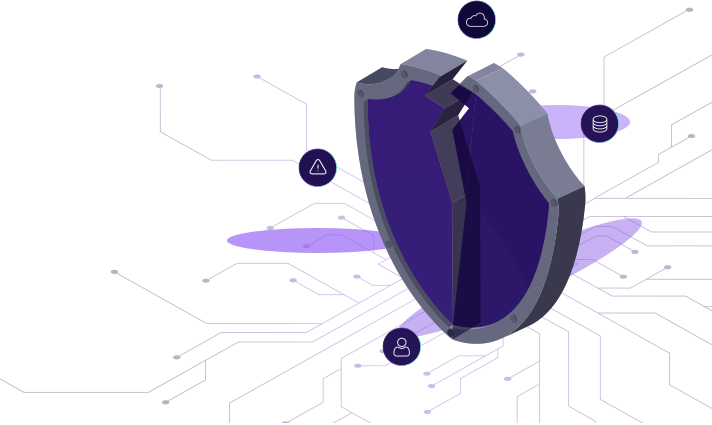

AppSec & DLP
Focus on inputs and outputs, not logic, memory, or the actions agents take.

EDR/XDR
Detect system-level threats, but miss mulit-step agent behavior and decision-making context.

CNAPP & CSPM
Govern cloud infrastructure, not agents running inside applications or invoking external tools.
Outcomes That Drive
Secure AI Adoption

Use Case
Enable security teams to discover and inventory agents, so they can enforce policies and reduce unmanaged risk.

Benefit
Operate with confidence; know AI agents are secure, governed, and under control.

Business Outcomes
Ready to Secure Your AI Agents?
Join leading enterprises who trust Zenity to secure their AI agent deployments across SaaS, Cloud, and Endpoint environments.
Get a DemoFrequently Asked Questions
Security agents are AI agents or automated systems used to monitor, enforce, or respond to security risks; distinct from AI agents that need to be secured. Zenity's platform does both: it governs the security of every AI agent in your environment while using its own detection and policy-enforcement logic to act as a security layer in real time.
An AI agent security platform is purpose-built software that secures how AI agents behave, not just the models or prompts behind them. It typically covers discovery, posture management, access control, and runtime threat detection, applied specifically to autonomous, multi-step agent behavior rather than static inputs and outputs.
Securing AI agents requires visibility into what an agent can access, enforcement of policy before and during execution, and detection of threats like prompt injection, tool misuse, and unauthorized data access, covering the full lifecycle, not just one layer.
Traditional AppSec, EDR/XDR, and CNAPP tools weren't built to govern autonomous execution. They monitor inputs, outputs, or infrastructure, but miss the decision-making context; what an agent is trying to do and why, that determines whether an action is actually a risk.